

“Build it and they will come” has been the virality mantra for startups, especially PLG ones. But consumers have their own lives. Your product is not nearly as important to them as it is to you. Like it or not, you still need to find a way into their lives.
A great example is the recent surprise hit Hanuman Ansh, based on the story of Neem Karoli Baba, who was also a major influence on Steve Jobs.
The movie turned out to be a super flop in the first few days and then, the makers started embedding themselves in the consumer’s life..and the rest is history blockbuster!
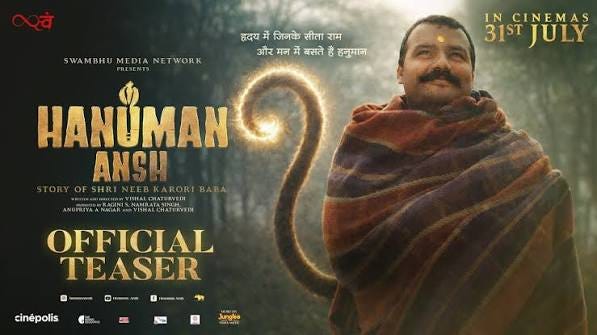
The Hanuman Ansh movie, created with a budget of around ₹1.5 - 2 crore ($170K-$225K), made only ~₹10 lakh ($11K) in its first few days.
It was nearly written off. Then something changed, and it started to grow. Here is what the makers did: apart from the inherent virality, they took specific actions and there is immense GTM lesson for companies (btw, the movie has made ~134 crores, $15.2 million, as of today).
1) they turned community rituals into their GTM engine
Instead of buying ads, the team organized eight bhandaras (free community meals) at temples and made these the core of their campaign.
Each bhandara served as both a spiritual act and a conversation hub about Neem Karoli Baba and the film.
For a devotional audience, this wasn’t marketing; it was seva + satsang, the way they already gather, talk, and form opinions.
Product analogy:
For human-centric products, your “bhandara” is the ritual where your users already meet: user groups, meetups, webinars, WhatsApp communities, internal champion programs.The question is: What value can you create in that ritual that naturally pulls people in and makes them talk?
2) they aligned with the right trust nodes, not generic influencers
The makers sought guidance from Premanand Maharaj and engaged with the existing spiritual ecosystem around Neem Karoli Baba devotees.
In this category, maharaj/satsang leaders > film stars as trust anchors.
Their endorsements (explicit or implicit) gave the film legitimacy that no trailer or poster could.
Product analogy:
In B2B or community products, your “maharaj” might be respected practitioners, category experts, internal champions, or power users or analysts (in VC firms).Answer: Who does your audience already trust when deciding what’s worth their time? Build for them first; the rest follows.
Sounds cheesy? Ignore and live with the hardship of sales :)
3) they designed the experience to feel like darshan, not just entertainment
Audiences began treating theaters like temples: removing shoes, folding hands, crying, and calling it a “satsang.”
The team didn’t fight this; they kept the tone sacred, avoided gimmicky promotion, and let the experience reinforce the spiritual “why.”
This made people feel proud to bring family and community, not just to watch a movie.
Product analogy:
If your product touches identity, faith, health, career, or money, the experience must match the emotional weight of the job. A “fun” onboarding for something serious can break trust.Ask: Does our UX match the emotional gravity of the user’s problem?
4) they were willing to be “slow” and read weak signals
The film opened on ~250 screens, dropped to ~25, and was considered dead by conventional metrics.
But the team listened to community signals (full houses in certain towns, temple buzz, social posts) and let those dictate where to push.
Exhibitors responded by adding shows and screens once they saw repeat attendance and strong hold, not just Day-1 numbers.
Product analogy:
Most startups kill products that don’t spike in Week 1. Human-centric products often need community discovery time.The skill is: Can you spot early advocacy loops (repeat usage, unsolicited referrals, community chatter) and double down there, even if top-line looks weak?
5) they made the audience the PR department
Director Vishal Chaturvedi said: “We hardly did any promotion and PR. The audience played the role of PR with word-of-mouth and posting on social media.”
No big press tours, no paid influencer blitz.
Instead: real stories, real emotions, real rituals that people wanted to share as part of their identity.
Product analogy:
For PLG and community products, your best PR is:
Users sharing wins (“This saved my quarter”)
Teams showcasing workflows built on your tool
Communities treating your product as part of their story
The founders’ job is to engineer moments worth sharing and then remove friction from that sharing.
The pattern for human-centric, virality products
If you translate Hanuman Ansh into a playbook for startups:
Start from the ritual, not the channel
Where does your audience already gather and talk? Build value inside that ritual (bhandara = community event/value moment).Win the trust nodes, not the masses
Identify the 5, 10 people/roles whose endorsement changes minds in your category. Design specifically for them.Match experience to emotional job
If the job is sacred/serious/identity-laden, your UX, tone, and rituals must reflect that. Don’t dilute it for broader appeal.Optimize for loops, not launches
Measure: repeat usage, referrals, community chatter, champion activity. Be ready to go slow until loops prove themselves.Make users your PR
Give them stories, artifacts, and status they can share. Then get out of the way.
“Build it and they will come” works only when what you build fits a real human ritual, is trusted by the right nodes, and creates experiences people are proud to recommend.
Hanuman Ansh didn’t beat the system; it understood the humans behind it.
What about you? What part of your customer do you understand so damn well which your competition can’t even touch?